
Lineman Salary in 2026: How Much Do Power Linemen Make?
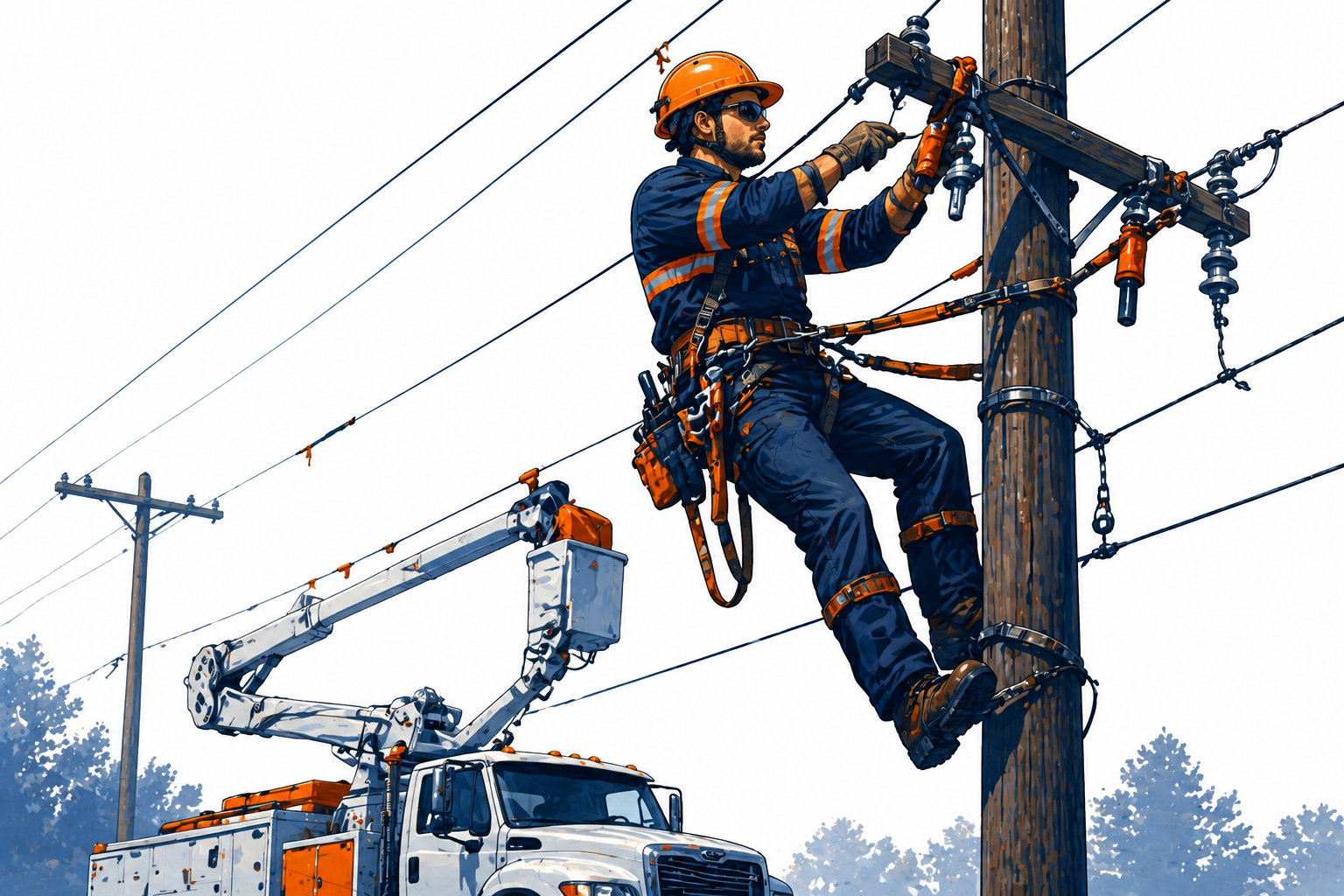
When the power goes out - whether from a hurricane, ice storm, or equipment failure - linemen are the ones who put it back on. They climb 100-foot poles. They work with high-voltage electricity that can kill in an instant. They do it in pouring rain, freezing cold, and blistering heat.
And they get paid extremely well for it.
Lineman is one of the highest-paying trade careers in America. The combination of danger, skill, and demand puts lineman pay well above most other trades. And storm work can push annual earnings far past six figures.
This guide breaks down real lineman salary data for 2026.
Lineman Salary Overview
Here are the verified numbers for 2026:
- Apprentice (Year 1-2): $40,000 to $55,000 per year
- Journeyman (Year 3-5): $65,000 to $85,000 per year
- Experienced Journeyman (Year 5-10): $80,000 to $100,000 per year
- Foreman / Senior Lineman (10+ years): $95,000 to $130,000+ per year
National median: approximately $95,320 per year or about $45.83 per hour according to the Bureau of Labor Statistics.
But the median is just the starting point. Linemen who work overtime, take storm assignments, and travel for work regularly earn $100,000 to $150,000+. Some linemen in heavy storm years have earned $200,000+ in a single year.
The Bureau of Labor Statistics projects 10% job growth for electrical power-line installers through 2035 - faster than average. Grid modernization, renewable energy connections, and EV charging infrastructure are all driving demand higher.
Why Linemen Get Paid So Much
Three factors drive lineman pay above most other trades:
1. The danger is real. Linemen work with high-voltage electricity at extreme heights. One mistake can be fatal. According to the Bureau of Labor Statistics, power line work is among the most dangerous occupations in America. That risk is reflected in the pay.
2. The conditions are brutal. You don't get to choose when a storm hits. Linemen work in hurricanes, ice storms, blizzards, and heat waves. They work nights, weekends, and holidays. The job demands physical toughness and mental resilience that most people don't have.
3. The skill is specialized. Not just anyone can do this work. It requires years of training, specific certifications, and the ability to work safely with electricity that can arc through the air. The combination of physical ability, technical knowledge, and willingness to work in dangerous conditions narrows the talent pool significantly.
Salary by Type of Lineman
Not all lineman work is the same. The type of work you do significantly affects your pay.
Distribution Lineman
$65,000 to $90,000 per year
Working on the local power distribution network - the lines that carry electricity from substations to homes and businesses. This is the most common type of lineman work. You build new distribution lines, maintain existing ones, and restore power after outages.
Most linemen start here. The work is steady, the hours are more predictable than transmission or storm work, and you're typically close to home.
Transmission Lineman
$80,000 to $115,000 per year
Working on high-voltage transmission lines - the big lines on tall steel towers that carry electricity across long distances from power plants to substations. These lines carry significantly higher voltage than distribution lines.
Transmission work pays more because:
- Higher voltage = higher danger
- More specialized knowledge required
- Often requires travel to remote locations
- Projects are larger and more complex
Storm Restoration Lineman
$100,000 to $200,000+ per year (variable)
This isn't a separate job title - it's what happens when storms hit. Linemen from across the country travel to storm-affected areas to restore power. The pay during storm work is extraordinary.
Storm pay typically includes:
- Double-time or triple-time hourly rates
- 16-hour days for weeks at a time
- Per diem of $50 to $150/day for meals and expenses
- Travel pay for driving to the storm area
- Hotel/lodging paid by the employer
A single major storm restoration assignment can pay $15,000 to $40,000+ for 2-3 weeks of work. Linemen who chase multiple storms in a year can add $50,000 to $100,000 or more to their annual income.
Hurricane season (June-November) is the biggest earning opportunity. Linemen who work hurricane restoration in Florida, Texas, Louisiana, and the Carolinas earn massive overtime.
Telecommunications Lineman
$50,000 to $72,000 per year
Installing and maintaining fiber optic cable, telephone lines, and cable TV infrastructure. Lower voltage means lower danger and lower pay compared to power linemen. But broadband expansion is driving strong demand.
Substation Technician
$70,000 to $95,000 per year
Maintaining and repairing electrical substations - the facilities that step voltage up or down between transmission and distribution lines. Specialized work that requires deep knowledge of transformers, breakers, and control systems.
Salary by State
Lineman pay varies by location. States with extreme weather, high cost of living, or strong union presence pay the most.
Highest paying states for linemen:
- California: $100,000 to $120,000+ average
- New York: $95,000 to $115,000
- Illinois: $90,000 to $110,000 (strong IBEW presence)
- Alaska: $88,000 to $105,000
- Oregon: $85,000 to $100,000
- Washington: $85,000 to $100,000
- Massachusetts: $85,000 to $100,000
- New Jersey: $82,000 to $98,000
States with solid but lower base pay:
- Texas: $65,000 to $82,000 (but heavy storm overtime)
- Florida: $62,000 to $78,000 (hurricane season overtime is massive)
- Georgia: $60,000 to $75,000
- Ohio: $65,000 to $80,000
- North Carolina: $60,000 to $75,000
Don't sleep on southern states. The base pay looks lower but hurricane and storm work adds $20,000 to $60,000+ in overtime for linemen willing to work storm restoration. A Florida lineman earning $70,000 base can easily clear $120,000+ in a heavy hurricane year.
Apprentice Lineman Pay Progression
The lineman apprenticeship is one of the best-paying apprenticeships in any trade.
Year 1: $20 to $26 per hour / $42,000 to $54,000
- Learning pole climbing, safety, basic line work
- Assisting journeymen on crew
- Classroom instruction on electrical theory
Year 2: $24 to $32 per hour / $50,000 to $66,000
- Handling more tasks independently
- Learning to work with energized lines
- Starting to drive line trucks
Year 3: $28 to $36 per hour / $58,000 to $75,000
- Working independently on many tasks
- Advanced skills - hot stick work, transformer installation
- May start participating in storm restoration
Year 4: $32 to $40 per hour / $66,000 to $83,000
- Final year before journeyman test
- Handling complex work under minimal supervision
- Ready to test for journeyman status
After apprenticeship → Journeyman Lineman: $38 to $50+ per hour / $80,000 to $100,000+
Total earnings during a 4-year apprenticeship: approximately $210,000 to $280,000. You earn a quarter-million dollars while learning a trade that will pay you six figures for the rest of your career. No student debt. No tuition. Just income.
How to Become a Lineman
Step 1: Meet Basic Requirements
- Age: 18+ (some programs require 21)
- Education: High school diploma or GED
- Driver's license: Valid, clean driving record
- CDL: Class A CDL required (most programs help you get this)
- Physical fitness: Must be able to climb poles, lift 50+ lbs, work at heights
- No fear of heights: This is non-negotiable
- Pass drug test and background check
Step 2: Get Pre-Apprenticeship Training (Recommended)
Lineman pre-apprenticeship programs (also called lineman schools) run 10 to 15 weeks and teach:
- Pole climbing
- Basic electrical theory
- CPR and first aid
- CDL preparation
- Tool identification and use
- Safety procedures
Cost: $5,000 to $15,000 for private lineman schools. Some community colleges offer programs for less.
Is it required? Not always. But completing a pre-apprenticeship program significantly improves your chances of getting into a lineman apprenticeship. Some programs have direct pipelines to utilities and contractor apprenticeships.
Step 3: Enter a Lineman Apprenticeship
IBEW/ALBAT (union) apprenticeship:
- 4-year program through IBEW and the American Line Builders Apprenticeship Training program
- 7,000+ hours of on-the-job training
- 680+ hours of classroom instruction
- Paid from day one with scheduled raises
- Best training, best pay, best benefits
- Competitive to get in - pre-apprenticeship training helps
Utility company apprenticeship:
- Many utilities (Duke Energy, PG&E, Dominion, Florida Power & Light, etc.) run their own lineman apprenticeship programs
- Similar structure to IBEW - 3 to 4 years
- Often include CDL training and company-specific procedures
- Job security with a major utility
Contractor apprenticeship:
- Line construction contractors hire apprentices for new line construction, storm work, and infrastructure projects
- More travel, more overtime, more pay variability
- Good option if you want to maximize earnings through storm work
Find apprenticeships at apprenticeship.gov or contact your local IBEW union hall.
Step 4: Earn Your Journeyman Certification
After completing your apprenticeship, you take the journeyman lineman exam. Pass it and you're a fully qualified journeyman lineman - one of the highest-paid trade workers in America.
Union vs Non-Union Lineman Pay
Union linemen (IBEW):
- Average pay: $85,000 to $110,000+ per year
- Pension and defined benefit retirement
- Health insurance included
- Structured apprenticeship with the best training
- Overtime protections and guaranteed rates
- Storm restoration pay at premium rates
- Total compensation (pay + benefits): $100,000 to $140,000+
Non-union linemen:
- Average pay: $65,000 to $90,000 per year
- Benefits vary by employer
- More flexibility in choosing employers and projects
- May have opportunities with smaller contractors
- Storm work still available but rates may be lower
The union advantage is substantial for linemen. IBEW linemen consistently earn more than non-union counterparts, and the pension benefits add significant long-term value. Most linemen who can get into the IBEW recommend it.
Overtime and Storm Work: The Real Money
Overtime is where lineman pay goes from great to exceptional.
Regular overtime: At $40/hour base, overtime pays $60/hour. Working 50-hour weeks adds $31,200 per year.
Storm overtime: Storm rates are often double-time or triple-time. At $40/hour base:
- Double-time: $80/hour
- Triple-time: $120/hour
A typical storm restoration assignment:
- 16-hour days for 14 to 21 days straight
- Double-time for hours over 8 per day
- Per diem of $75 to $150/day
- Travel pay
Example: 2 weeks of storm work at 16 hours/day:
- Regular hours (8/day × 14 days): 112 hours × $40 = $4,480
- Overtime hours (8/day × 14 days): 112 hours × $80 = $8,960
- Per diem: 14 days × $100 = $1,400
- Total for 2 weeks: approximately $14,840
That's nearly $15,000 for two weeks of work. Linemen who chase multiple storms per year can add $30,000 to $80,000+ to their annual income.
The Physical and Mental Demands
This section matters because lineman work isn't for everyone. You need to know what you're getting into.
Physical Requirements
- Climbing: You'll climb wooden poles, steel structures, and lattice towers. Some are 40 feet. Some are 100+ feet.
- Lifting: Carrying tools, equipment, and hardware that weighs 50+ pounds. Sometimes 100+ pounds.
- Working in all weather: Rain, snow, ice, extreme heat, wind. The weather doesn't care about your comfort.
- Standing and walking: Long days on your feet on uneven terrain.
- Upper body strength: Climbing with gear requires serious arm, shoulder, and grip strength.
Fitness matters. Many lineman programs have physical fitness tests. If you're not in shape, start training before you apply. Climbing poles with 30+ pounds of gear requires real strength and endurance.
Mental Requirements
- Comfortable with heights: If you're afraid of heights, this is not your career. Full stop.
- Safety awareness: One lapse in attention around high-voltage lines can be fatal.
- Time away from home: Storm work and travel assignments take you away from family. This is the hardest part for many linemen.
- Stress management: Working in dangerous conditions during emergencies requires calm under pressure.
The divorce rate among linemen is higher than average because of the time away from home. If you have a family, make sure your partner understands what this career involves before you commit. The money is great but the time away is real.
Lineman vs Other Electrical Careers
Lineman vs Electrician:
- Linemen earn more ($82,000 median vs $63,190 for electricians)
- Linemen work outdoors; electricians work indoors
- Lineman work is more dangerous
- Linemen travel more, especially for storm work
- Electricians have more predictable schedules
- Both offer excellent career potential
Lineman vs HVAC Technician:
- Linemen earn significantly more
- HVAC has faster entry (6 months to 2 years vs 4 years)
- HVAC is less dangerous and less physical
- Linemen have more overtime opportunities
- Both have strong job security
For a complete comparison of all trades, check out our highest paying trade jobs guide.
Career Advancement for Linemen
Journeyman Lineman → Foreman
- Pay: $90,000 to $120,000+
- Lead a crew of 4-6 linemen
- Manage job site safety and workflow
- First step into management
Foreman → General Foreman
- Pay: $100,000 to $140,000+
- Oversee multiple crews on large projects
- Coordinate with project managers and engineers
General Foreman → Superintendent
- Pay: $110,000 to $160,000+
- Manage entire projects from start to finish
- Budget responsibility and client communication
Superintendent → Project Manager / Operations Manager
- Pay: $120,000 to $180,000+
- Office-based leadership role
- Multiple project oversight
Alternative path → Line Contractor / Business Owner
- Pay: $150,000 to $300,000+ (variable)
- Running your own line construction company
- Bidding on utility contracts and storm restoration work
- Highest risk and highest reward
Alternative path → Utility Management
- Pay: $90,000 to $150,000
- Working for a utility company in a management role
- Better work-life balance than field work
- Stable income with good benefits
Tips to Earn More as a Lineman
1. Get into the IBEW. Union linemen earn the most in base pay plus benefits. The training is the best in the industry.
2. Say yes to storm work. Storm restoration is where linemen make extraordinary money. Be willing to travel and work long hours during emergencies.
3. Get your CDL early. A Class A CDL is required for most lineman positions. Having it before you apply gives you an advantage.
4. Pursue transmission work. Transmission linemen earn more than distribution linemen because of the higher voltage and complexity.
5. Move to a high-paying state. California, New York, and Illinois linemen earn $90,000 to $120,000+ base. Or live in a southern state and chase storm work for the best of both worlds.
6. Stay in shape. Physical fitness directly affects your productivity and safety on the job. Strong linemen climb faster, work longer, and have fewer injuries.
7. Build toward foreman. Leading a crew adds $10,000 to $30,000 per year to your income. Develop leadership skills alongside your technical skills.
Frequently Asked Questions
How long does it take to become a lineman? A pre-apprenticeship program takes 10 to 15 weeks. The apprenticeship takes 3 to 4 years. Total time from start to journeyman: approximately 4 to 5 years.
Is being a lineman dangerous? Yes. It's one of the most dangerous trades. Electrocution, falls from height, and struck-by incidents are the primary risks. Rigorous safety training and strict procedures reduce the danger, but the risk is never zero. The pay reflects this reality.
Can linemen make $200,000 a year? In exceptional years with heavy storm work, yes. A journeyman lineman earning $85,000 base who works two or three major storm restorations can add $50,000 to $100,000+ in overtime. $200,000 years are not typical but they happen.
Do linemen travel a lot? It depends on your employer. Utility linemen typically work within their service area and come home every night. Contractor linemen and storm chasers travel extensively - sometimes weeks or months at a time.
What's the hardest part of being a lineman? Time away from family. The physical demands are tough, the danger is real, but most linemen say the hardest part is missing birthdays, holidays, and family events because you're 500 miles away restoring power after a hurricane.
Is lineman work good for young people? If you're physically fit, not afraid of heights, and want to earn $80,000+ within a few years of starting, lineman is one of the best trades for 18 year olds. The apprentice pay alone is better than most jobs available to 18-year-olds.
Do I need to go to lineman school before the apprenticeship? It's not always required but it significantly improves your chances of being accepted. A 10-15 week pre-apprenticeship program teaches climbing, basic skills, and safety. It shows employers you're serious.
Lineman vs electrician - which is better? Linemen earn more but the work is more dangerous, more physical, and requires more time away from home. Electricians have more predictable schedules and can work indoors. Both are excellent careers. It comes down to what kind of work environment suits you.
What to Do Right Now
- Assess your fitness. Can you climb? Are you strong enough to carry heavy gear? Start training now if you're not in shape. Pull-ups, grip strength, cardio, and leg endurance are critical.
- Get comfortable with heights. If you've never been higher than a second-story roof, find opportunities to experience heights safely. Rock climbing gyms are a good start.
- Search for lineman pre-apprenticeship programs in your area. Check community colleges and private lineman schools.
- Contact your local IBEW hall to ask about lineman apprenticeship opportunities. Visit ibew.org to find your nearest local.
- Start your CDL. Many lineman positions require a Class A CDL. Getting it early gives you an advantage. See our CDL training cost guide.
- Compare lineman careers to other options in our highest paying trade jobs guide, electrician salary guide, and electrician apprenticeship guide.
When the lights go out, everyone counts on linemen to turn them back on. It's dangerous. It's demanding. It's not for everyone. But for the people who can handle it, lineman work offers some of the highest pay in any trade - with storm earnings that can push well past six figures. If you're tough enough, this career will reward you for decades.
Interested in Automotive?
APEX Tech Nation is the go-to platform for automotive technicians. Free AI diagnostics, training, ASE prep, and a community of working techs. Built by Anthony Calhoun.
Visit APEX Tech Nation