
Plumber Salary in 2026: How Much Do Plumbers Really Make?
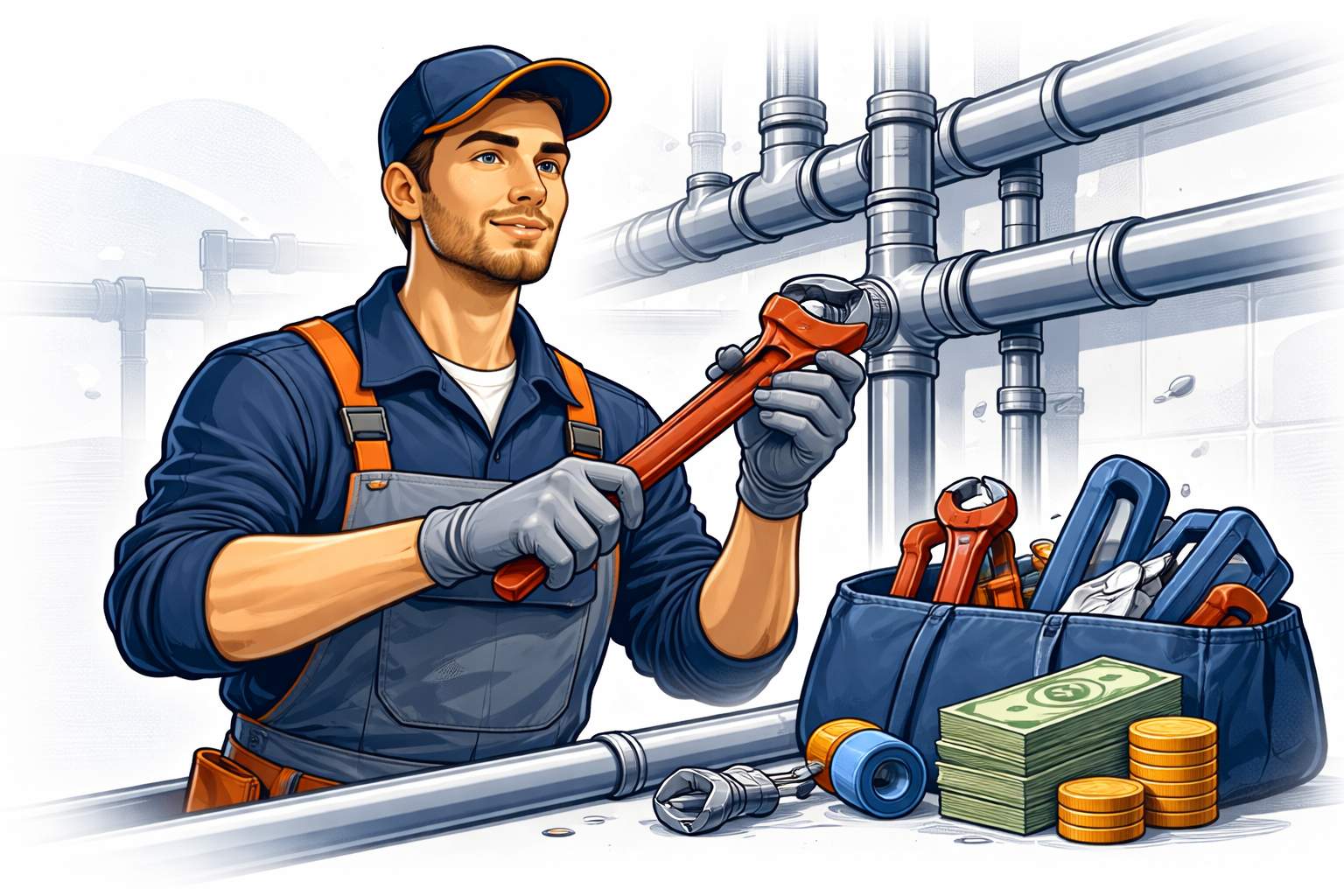
Every building in America needs plumbing. Every home. Every office. Every hospital. Every restaurant. And when that plumbing breaks at 2 AM on a Sunday, somebody has to fix it.
That somebody gets paid very well.
Plumbing is one of the most stable and highest-paying trades in the country. The work can't be outsourced. It can't be automated. And there aren't nearly enough plumbers to meet demand.
This guide breaks down real plumber salary data for 2026 so you know exactly what to expect at every stage of your career.
Plumber Salary Overview
Here are the verified numbers for 2026:
- Apprentice (Year 1-2): $32,000 to $42,000 per year
- Journeyman (Year 3-5): $50,000 to $65,000 per year
- Experienced Journeyman (Year 5-10): $60,000 to $78,000 per year
- Master Plumber (10+ years): $75,000 to $100,000+ per year
National median: approximately $63,800 per year or about $30.67 per hour according to the Bureau of Labor Statistics.
But the real money is at the top. Master plumbers who run their own businesses regularly earn $100,000 to $200,000+. Plumbers who specialize in commercial or industrial work earn $80,000 to $110,000 working for someone else.
The Bureau of Labor Statistics projects 7% growth for plumbing jobs through 2035. That sounds small until you factor in retirements - thousands of experienced plumbers leaving the trade every year with not enough young plumbers to replace them. The real-world demand is much higher than that 2% suggests.
Salary by Experience Level
Apprentice Plumber (Year 1-2)
$15 to $20 per hour / $32,000 to $42,000 per year
As an apprentice, you're learning the trade under a licensed plumber. You'll dig trenches, carry materials, cut pipe, assist with installations, and learn the basics of residential plumbing systems.
Apprentice pay increases every 6-12 months. Most programs give scheduled raises as you advance through your training. By the end of your apprenticeship, you're earning close to journeyman wages.
Journeyman Plumber (Year 3-5)
$24 to $31 per hour / $50,000 to $65,000 per year
You've passed your journeyman exam and earned your license. You can work independently, pull permits (in some states), and handle most residential and light commercial jobs on your own.
This is where your income jumps. The difference between apprentice and journeyman pay is significant - often a $15,000 to $20,000 per year increase.
Experienced Journeyman (Year 5-10)
$29 to $38 per hour / $60,000 to $78,000 per year
You're fast, efficient, and experienced. You handle complex jobs, train apprentices, and might lead crews on larger projects. Employers value experienced journeymen who can work independently and solve problems.
Master Plumber (10+ Years)
$36 to $48 per hour / $75,000 to $100,000+ per year
You've passed the master plumber exam - the highest license in the trade. You can:
- Pull permits independently
- Design plumbing systems
- Run your own plumbing business
- Supervise journeymen and apprentices
- Bid on commercial and government contracts
Master plumbers who own their own businesses often earn $100,000 to $200,000+. The master license is your ticket to business ownership and the highest earning potential in plumbing.
Salary by State
Location makes a big difference in plumber pay. States with higher cost of living and strong union presence pay more.
Highest paying states for plumbers:
- Illinois: $82,000 to $95,000 (strong union presence)
- Alaska: $78,000 to $90,000
- Massachusetts: $76,000 to $88,000
- New Jersey: $74,000 to $86,000
- New York: $72,000 to $85,000
- Oregon: $70,000 to $82,000
- Washington: $70,000 to $82,000
- Minnesota: $68,000 to $80,000
States with solid but lower pay:
- Texas: $52,000 to $65,000
- Florida: $48,000 to $62,000
- Georgia: $48,000 to $60,000
- Ohio: $50,000 to $64,000
- North Carolina: $48,000 to $60,000
Remember: Lower-paying states usually have a lower cost of living. A $55,000 salary in Texas can provide the same lifestyle as $80,000 in New Jersey. Always factor in housing, taxes, and living expenses.
Salary by Specialty
Plumbing isn't just one job. Specializing in a high-demand area pushes your pay up significantly.
Residential Plumber
$48,000 to $70,000 per year
New construction, remodels, repairs, drain cleaning, water heaters. This is where most plumbers work. The work is steady and familiar. Residential service plumbers who handle emergency calls often earn more because of overtime and after-hours premiums.
Commercial Plumber
$60,000 to $85,000 per year
Working on larger systems in office buildings, hospitals, schools, retail stores, and restaurants. Commercial plumbing involves bigger pipes, more complex systems, and stricter code requirements. The complexity means higher pay.
Industrial Plumber / Pipefitter
$65,000 to $100,000+ per year
Installing and maintaining piping systems in factories, power plants, refineries, and chemical plants. Industrial work often overlaps with pipefitting and steamfitting. The pay is higher because the systems are more complex and the environments are more demanding.
Medical Gas Plumber
$65,000 to $90,000 per year
Specializing in the piping systems that deliver oxygen, nitrous oxide, and other gases in hospitals and medical facilities. This requires specialized certification and precision. Mistakes can be life-threatening, which is why the pay is premium.
Fire Sprinkler Installer
$55,000 to $78,000 per year
Installing fire suppression systems in commercial and residential buildings. This is a specialized niche within plumbing that has its own licensing requirements in most states. Growing demand as fire codes become stricter.
Service / Repair Plumber
$55,000 to $80,000 per year
Focusing on repairs, drain cleaning, and emergency service calls. Service plumbers who work for themselves or for companies that charge premium rates for emergency work can earn significantly more. The work is unpredictable but the pay reflects it.
New Construction Plumber
$50,000 to $72,000 per year
Roughing in plumbing for new homes and buildings. The work is physical - lots of drilling, cutting, and crawling through tight spaces. But new construction keeps you busy when the housing market is hot.
Union vs Non-Union Plumber Pay
Union plumbers typically earn more:
- Union average: $65,000 to $95,000 per year
- Pension and retirement benefits
- Health insurance included
- Structured apprenticeship with scheduled raises
- Work through the United Association (UA)
- Overtime protections and pay guarantees
Non-union plumbers have more flexibility:
- Non-union average: $50,000 to $75,000 per year
- Benefits vary by employer
- More freedom to choose jobs and employers
- Easier to start your own business
- Can negotiate pay individually
Union plumbers in major cities (Chicago, New York, Boston, San Francisco) regularly earn $85,000 to $100,000+ with benefits worth another $20,000 to $30,000 per year. The total compensation package is hard to beat.
Overtime: Where Plumbers Cash In
Plumbing emergencies don't wait for business hours. Burst pipes at midnight. Sewage backups on holidays. Frozen pipes in January. Emergency plumbing means overtime pay.
At $30/hour base, overtime pays $45/hour. Working just 10 extra hours per week adds $23,400 per year to your income.
Service plumbers who take after-hours calls often earn the most overtime. Some companies pay double-time for holidays and weekends. A plumber willing to work Thanksgiving or Christmas can earn $60/hour or more.
Many plumbers earn $10,000 to $20,000 per year in overtime alone. This is a significant income boost that salary averages don't capture.
How to Become a Plumber
Step 1: Get Your High School Diploma or GED
Basic requirement for almost all plumbing apprenticeships and training programs.
Step 2: Enter an Apprenticeship or Trade School
Apprenticeship (recommended):
- Length: 4 to 5 years
- Cost: $0 - you earn money from day one
- Find programs at apprenticeship.gov or contact your local UA union hall
- Combines on-the-job training (8,000+ hours) with classroom instruction (600+ hours)
Trade school / community college:
- Length: 6 months to 2 years for a certificate or associate degree
- Cost: $3,000 to $15,000
- Gives you a foundation before entering the workforce
- Financial aid available through FAFSA
For help choosing a training program, read our vocational training institute guide.
Step 3: Get Licensed
Plumbing licensing varies by state but generally follows this path:
Apprentice License → Work under a licensed plumber for 4-5 years
Journeyman License → Pass a written exam covering plumbing code, safety, and practical knowledge. You can now work independently.
Master Plumber License → After 2-4 more years as a journeyman (varies by state), pass the master exam. You can now pull permits, run a business, and supervise other plumbers.
The licensing process is longer than some trades but it's worth it. Licensed plumbers earn significantly more than unlicensed workers, and the master license is your key to business ownership.
Step 4: Keep Learning
Plumbing codes update regularly. New materials and technologies (PEX piping, tankless water heaters, smart plumbing systems) require ongoing education. Most states require continuing education credits to maintain your license.
The Path to Six Figures in Plumbing
Here's how plumbers break the $100,000 barrier:
Path 1: Master Plumber + Business Owner
This is the most common path to $100,000+. Get your master license, build your reputation, then start your own plumbing company.
Owner-operator plumber earnings:
- Year 1-2: $60,000 to $80,000 (building the business)
- Year 3-5: $80,000 to $120,000 (established client base)
- Year 5+: $120,000 to $200,000+ (multiple trucks and employees)
What you need:
- Master plumber license
- Business license and insurance
- A truck and tools
- Marketing (even a basic website and Google listing)
- Basic business management skills
- Reputation for quality work
Path 2: Union Commercial Plumber + Overtime
Union commercial plumbers in major metro areas earn $75,000 to $95,000 base. Add $15,000 to $25,000 in overtime and you're over $100,000 without owning a business.
Path 3: Specialization + Premium Rates
Medical gas plumbers, industrial pipefitters, and fire sprinkler specialists command premium rates. Combine a high-paying specialty with overtime and you can hit $100,000 as an employee.
Path 4: Plumbing Contractor
Instead of running a full plumbing company, some master plumbers work as independent contractors. They bid on jobs, hire helpers as needed, and keep the profit. Lower overhead than a full company but still strong income.
Plumbing vs Other Trades
How does plumbing compare to other trade careers?
Plumber vs Electrician:
- Very similar pay and career path
- Both require 4-5 year apprenticeships and licensing
- Plumbing is more physical, electrical is more technical
- Both have excellent business ownership potential
Plumber vs HVAC Technician:
- Similar pay range
- HVAC has shorter training (2-4 years vs 4-5 for plumbing)
- Plumbing has more licensing requirements
- Both have year-round demand
Plumber vs Welder:
- Welding has faster entry (6-12 months vs 4-5 years)
- Plumbers generally earn more long-term
- Plumbing offers clearer path to business ownership
- Welding is more physically demanding
Plumber vs CDL Driver:
- CDL has fastest entry (3-8 weeks)
- Plumbers earn more long-term and have more career advancement
- CDL drivers are away from home more
- Plumbing has much higher business ownership potential
For a complete comparison, check out our highest paying trade jobs guide.
Why Plumbing Is One of the Most Recession-Proof Careers
Plumbing doesn't care about the economy. Here's why:
Pipes break regardless of recessions. People need water. People need toilets. Sewage systems don't stop because the stock market dropped. Emergency plumbing work is constant in any economy.
New construction slows but repair work increases. During economic downturns, people repair rather than replace. They fix the old water heater instead of buying a new one. They patch the pipe instead of remodeling the bathroom. Repair plumbers stay busy even when construction plumbers slow down.
Aging infrastructure means more work. America's plumbing infrastructure is old. Lead pipes need replacing. Aging sewer systems need repair. Government infrastructure spending keeps plumbers working regardless of the private economy.
You can't outsource plumbing. Nobody's sending American plumbing jobs overseas. The work has to be done on-site, by a licensed professional, in person. This is true job security.
Tips to Earn More as a Plumber
1. Get your master license as fast as possible. Master plumbers earn $15,000 to $30,000 more per year than journeymen. And the master license opens the door to business ownership.
2. Take emergency and after-hours calls. Overtime and emergency premiums can add $10,000 to $20,000 per year. The work is inconvenient but the pay makes up for it.
3. Specialize. Commercial, industrial, medical gas, or fire sprinkler work all pay more than basic residential plumbing.
4. Start your own business. This is the ultimate path to six figures in plumbing. You don't need a huge company - many one-truck operations earn $100,000+.
5. Join the union. Union plumbers in major cities earn significantly more than non-union, especially when you factor in pension and health benefits.
6. Build your reputation. In plumbing, reputation is everything. Quality work, fair prices, and showing up when you say you will builds a client base that generates referrals for decades.
7. Learn code inside and out. Plumbers who know the plumbing code thoroughly are more valuable on complex projects. Code knowledge also helps you pass your journeyman and master exams.
Frequently Asked Questions
How long does it take to become a plumber? A full plumbing apprenticeship takes 4 to 5 years. After that, you take the journeyman exam. Master plumber licensure takes an additional 2 to 4 years of experience beyond journeyman.
Is plumbing a good career? Yes. Strong pay ($60,000 to $100,000+), excellent job security, recession-proof demand, clear path to business ownership, and the satisfaction of skilled work. It's one of the best trades you can enter.
Is plumbing hard on your body? Yes. You'll crawl under houses, dig trenches, work in cramped spaces, and lift heavy pipes. It's one of the more physical trades. Taking care of your body and using proper techniques is essential for a long career.
Do plumbers make more than electricians? They're very close. Both journeymen earn similar wages. Master plumbers and master electricians both earn $75,000 to $100,000+. Business owners in both trades can earn $150,000+. The trades are comparable in earning potential.
Can I become a plumber at 30 or 40? Yes. Many plumbers start later in life. The apprenticeship may feel long if you're starting at 35, but by 40 you'll be a licensed journeyman earning $60,000+ with decades of career ahead.
How much does it cost to start a plumbing business? A basic one-truck plumbing business costs $10,000 to $30,000 to start - truck, tools, insurance, licensing, and marketing. Many plumbers fund the startup from their journeyman savings. The return on investment is fast because overhead is low and rates are high.
Is plumbing in demand? Very much. The plumber shortage is significant and growing as experienced plumbers retire. The BLS projects steady demand through 2035 and beyond. In real-world terms, demand is even higher than the projections suggest.
What to Do Right Now
- Search for plumbing apprenticeships at apprenticeship.gov or contact your local UA (United Association) union hall.
- Look into plumbing programs at your local community college. Many offer certificate or associate degree programs that prepare you for the apprenticeship or direct employment. Read our vocational training institute guide for help choosing.
- Complete your FAFSA at fafsa.gov if you're considering trade school. Grants can cover most or all of your tuition.
- Talk to working plumbers in your area. Ask about their experience, their pay, and whether they'd recommend the career.
- Compare plumbing to other trades in our highest paying trade jobs guide, HVAC salary guide, and electrician apprenticeship guide.
- If you're 18 and choosing a career, plumbing is one of the strongest long-term choices. The apprenticeship takes 4-5 years but you're earning the entire time. By your mid-20s you'll be a licensed journeyman earning $60,000+ with a clear path to six figures.
Water flows. Pipes break. Toilets clog. It's not glamorous - but it's essential. And essential work pays well. Plumbing offers six-figure potential, bulletproof job security, and the ability to build a business that supports your family for decades. That's a career worth considering.
Interested in Automotive?
APEX Tech Nation is the go-to platform for automotive technicians. Free AI diagnostics, training, ASE prep, and a community of working techs. Built by Anthony Calhoun.
Visit APEX Tech Nation